Case study: Scottish and Southern Energy Networks
Aneesh Chandran | 3 minute read | 2 September 2021
Affordable and resilient protection of multi-ended transmission circuits
With the increasing integration of new renewable energy sources, Scottish and Southern Electricity Networks (SSEN) face challenges in protecting multi-ended transmission circuits efficiently and cost-effectively.
Synaptec partnered with SSEN to deploy a Distributed Electrical Sensing (DES) platform that provides real-time, accurate protection while simplifying infrastructure. This platform uses passive optical fibre sensors to monitor current over long distances, eliminating the need for multiple protection relays, and reducing overall system complexity and cost.
Accurate & reliable protection
Provides precise, real-time measurement for current differential protection
Scalable & flexible deployment
Supports up to 30 sensors over 60 km using a single optical fibre
Cost reduction & simplified infrastructure
Eliminates the need for multiple protection relays

SSEN are responsible for delivering electrical power to over 3.9 million homes and businesses across the north of Scotland and central southern England.
They are responsible for maintaining and investing in the electricity transmission network of these regions, which involves modernising, digitalising and decarbonising their existing network. They operate over 128,000 kilometres of overhead lines and underground cables, along with over 106,000 substations.
They are committed to keeping their customers connected whilst developing the flexible electricity network vital to achieving net zero.
The challenge
SSEN faced the challenge of providing robust, accurate, and cost-effective protection for new multi-ended transmission circuits, particularly where integration of renewable generation increases the complexity of the network.
Conventional distance and line differential protection systems posed significant drawbacks, including high infrastructure costs, complex installation requirements, space constraints, and reliance on precise time-synchronisation between remote locations. These limitations could lead to incorrect tripping due to poor accuracy levels or drifting zone reach.

Our solution
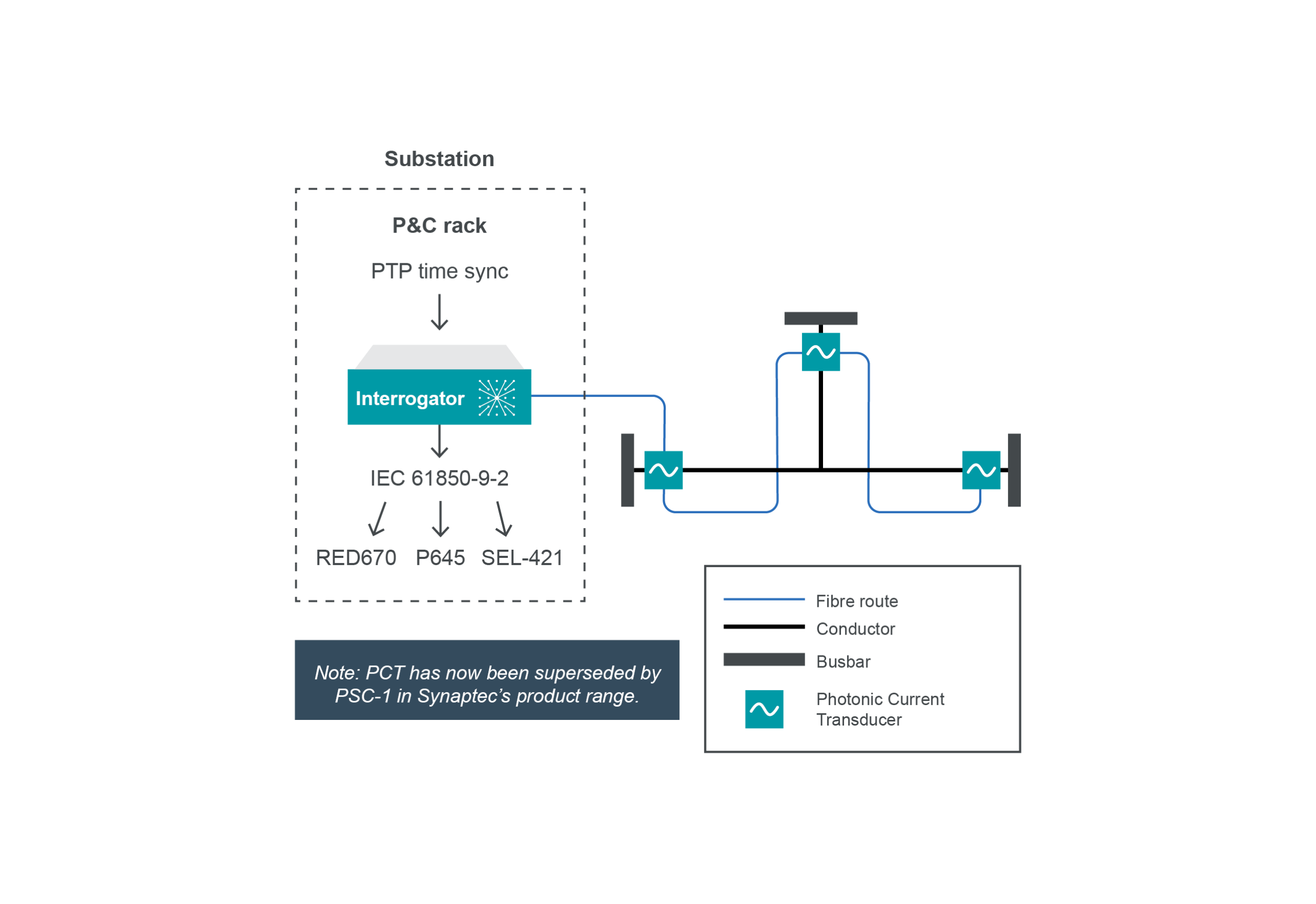
Synaptec solves the challenges of multi-ended circuit protection with accurate, cost-effective and scalable technology. DES is a proprietary technology platform developed in the UK by Synaptec, using specially modified FBGs (Fibre Bragg Gratings) to leverage the range and bandwidth of optical fibre. Measured values can be utilised as part of centralised Protection and Control (PAC) schemes, or communicated to traditional PAC devices for analysis via IEC 61850-9-2 / 61869-9.
This platform enables centralised measurement from up to 30 sensors over a 60 km radius using a single optical fibre, eliminating the need for multiple protection relays, complex telecommunications, and time-synchronisation systems. By simplifying infrastructure and reducing installation complexity, the solution provides accurate, reliable, and scalable protection for multi-ended circuits. Fully compliant with international IEC 61850 standards, the platform delivers cost-effective, real-time protection while supporting future expansion of the network.

Installation overview
Book a demo
Our solutions provide real-time, actionable insights to improve reliability and reduce operational costs. Discover how Synaptec can enhance your power system monitoring by speaking to one of our team today.
Applications


Related posts

Synthesis® Server
Synthesis® Server provides convenient and secure local hosting of the Synthesis® Core and Visual Core software. It provides a one-box, turn-key solution for collecting and interpreting high-resolution data from many Interrogators, and other data sources. It is...

Synaptec announces million pound sensor system order from Proserv
Unique sensor technology to be integrated into ECG™, Proserv’s holistic subsea cable monitoring system for offshore wind. Synaptec Ltd, the Scottish supplier of passive electrical monitoring systems for power networks, today announced that it has received a...

Passive Temperature Transducer (PTT)
Synaptec’s range of Passive Temperature Transducers (PTT) utilises established, high-performance temperature measurement techniques which are fully compatible with our Distributed Electrical Sensing (DES) technology, enabling remote circuits to be instrumented...
Sectors we support

Power grids

Renewables