Case study: The Tata Power Company Limited
Aneesh Chandran | 3 minute read | 28 April 2026
Auto-reclose blocking via Mixed Circuit Protection
for Tata Power’s Mandale substation
Tata Power Mumbai commissioned the Mumbai Metropolitan Region (MMRDA) Mandale 110kV receiving substation in late 2025 in order to loop-in loop-out the Dharavi – Vikhroli line. This will provide traction power supply for the Mumbai metro railway, which required an additional 3km, 110kV underground cable added in both lines. Synaptec’s Mixed Circuit Protection (MCP) solution was awarded the public tender, as the most cost-effective solution. The deployment of MCP provides improved post-event protection response by permitting auto-reclose on transient overhead faults, while blocking auto-reclose for faults within cable sections.
Safe and discrete auto-reclose on mixed circuit
Prevents catastrophic damage by ensuring the breaker never recloses on a permanent fault in a cable section
Scalable
Enables multi-zone fault discrimination over unprecedented distances
Cable health insights
Passive sensing requires no supporting infrastructure, enabling safe retrofitting to existing infrastructure, minimising downtime and operational disruption
Tata Power, established in 1915, is India’s largest integrated power company. It has an installed generation capacity of around 26 GW and supplies electricity to approximately 13 million distribution customers across India as well as in South Africa, Saudi Arabia, the UAE, Indonesia, Georgia, Mauritius, Zambia, and Bhutan.
Synaptec’s partner, Madhav Engineers Pvt. Ltd., is a Mumbai-based pioneer in electrical testing, operations, and maintenance equipment. Founded in 2003, the company focuses on introducing and adapting advanced technological innovations across a wide range of products and services.

The challenge
The Mumbai Metropolitan Region Development Authority (MMRDA) is responsible for long‑term regional planning, developing new growth centres, and delivering major infrastructure projects across the Mumbai Metropolitan Region. As part of this mandate, the authority initiated the construction of a world‑class metro system to support the city’s rapid expansion.
To power the new metro line, the traction substation needed to be fed from Tata
Power’s Dharavi–Vikhroli 110 kV transmission corridor. This required creating a loopin loop-out arrangement at the Mandale substation, and laying approximately 3 km of underground cable for both circuits, introducing a hybrid network of overhead and underground sections.
This mixed configuration created a significant protection challenge. The system needed to reliably distinguish between transient faults occurring on the overhead line and permanent faults in underground cables, something conventional protection schemes struggle to achieve cost-effectively at this scale and complexity.

Our solution
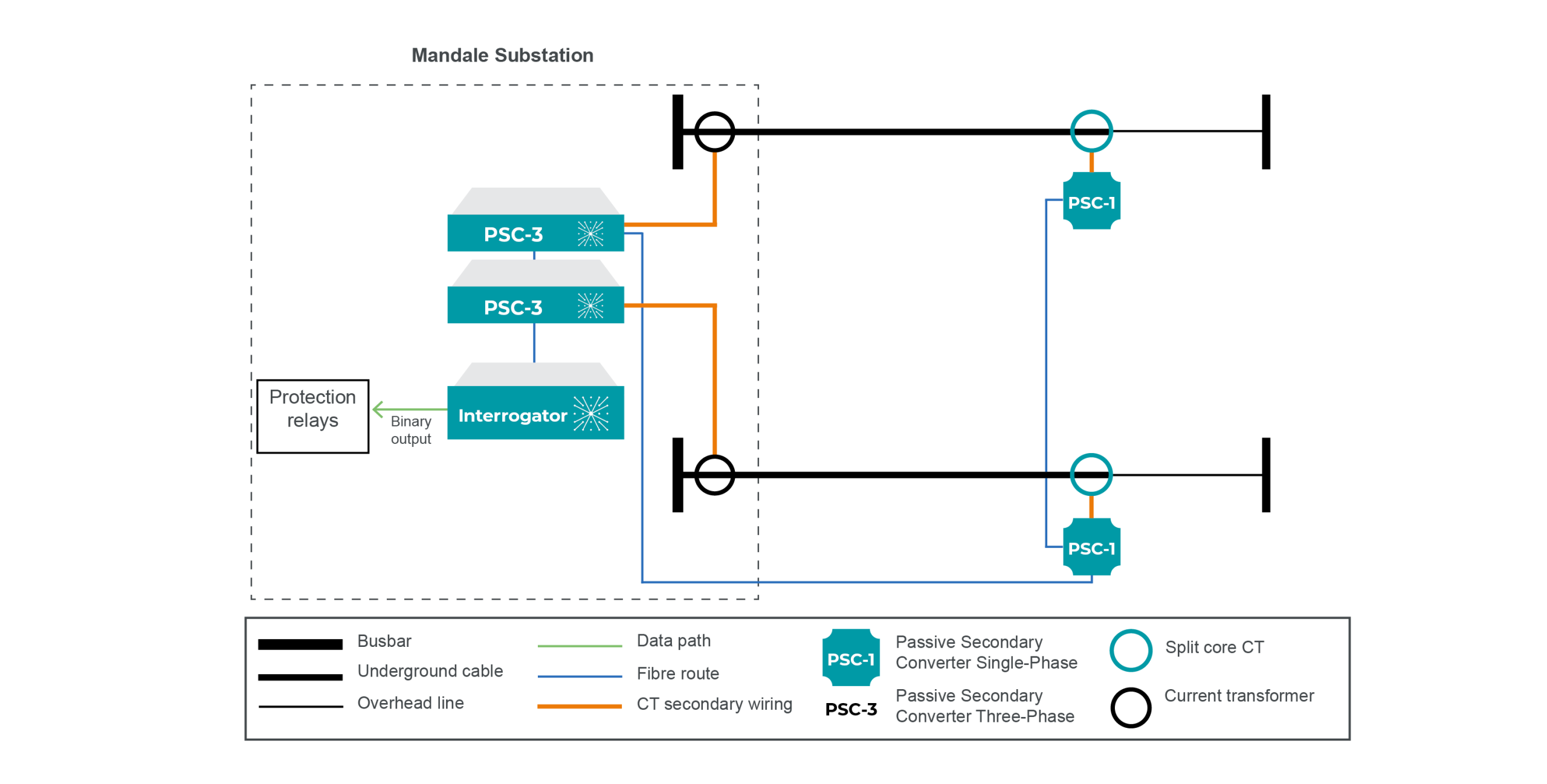
Synaptec’s Mixed Circuit Protection (MCP) solution is designed to overcome these challenges by using Distributed Electrical Sensing (DES) to determine, within milliseconds, whether a fault is located on the overhead line or the underground cable, before the breaker even operates. In this way power can be restored rapidly and safely after transient overhead line faults, and permanent cable faults will never be exposed a second time to dangerous fault-level currents.
By utilising the existing optical fibre in the transmission network, passive sensors were installed at cable sealing ends to capture current measurements. These sensors require no control power, data networks, maintenance or recalibration at any remote location. Their compatibility with industry-standard Current Transformers (CTs) also reduces the cost and footprint of equipment , and the duration of planned outages needed for installation. Unlike non-conventional instrument transformers (NCITs) or optical CTs (OCTs), Synaptec sensors require no specialist fibre winding on-site, and are immune to environmental factors like EM interference and ambient temperature changes – all of which can impact measurement performance of OCTs.
At the remote transition tower, Synaptec deployed an IP68‑rated single‑phase Passive Secondary Converter for Current (PSC‑1‑C) and a split‑core CT on each phase of the power cables, positioned just below the termination bushings. These sensors
collect measurements which are sent back as analogue light signals (not data) to the substation via the existing optical fibre. Within the substation, two three‑phase Passive Secondary Converters for Current (PSC‑3‑C) and one DES Interrogator were rack‑mounted and connected to the protection core of the existing GIS CTs. This meant only one Interrogator was required to monitor twelve passive sensors and create two discrete protection zones, in parallel, between the GIS and the transition tower.
The DES Interrogator identifies faults in under five milliseconds and immediately issues a trip signal through conventional dry contacts. This enables Tata Power to achieve fast, highly accurate protection responses, by issuing Auto‑Reclose blocking commands for permanent cable section faults, and by allowing Auto‑Reclose on overhead line section faults.
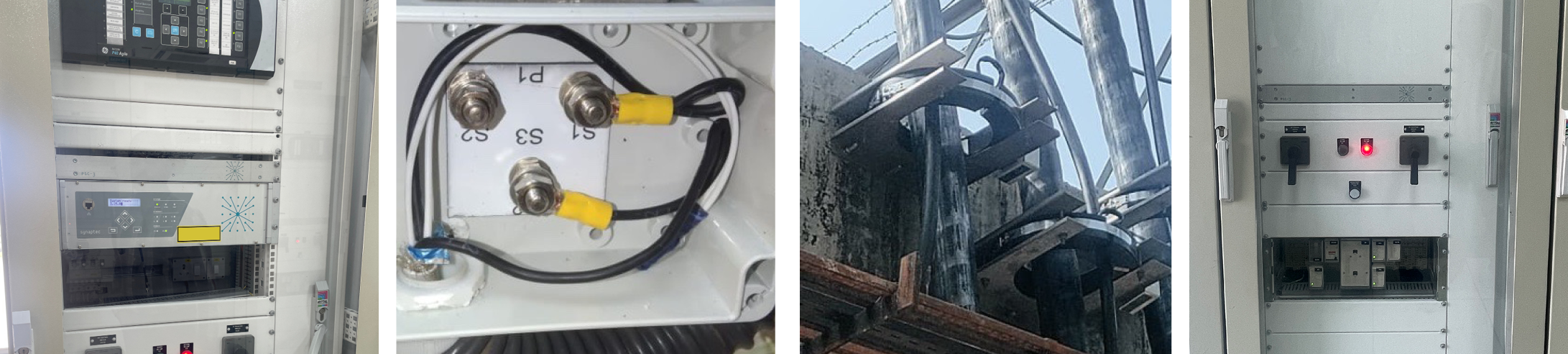
Installation overview
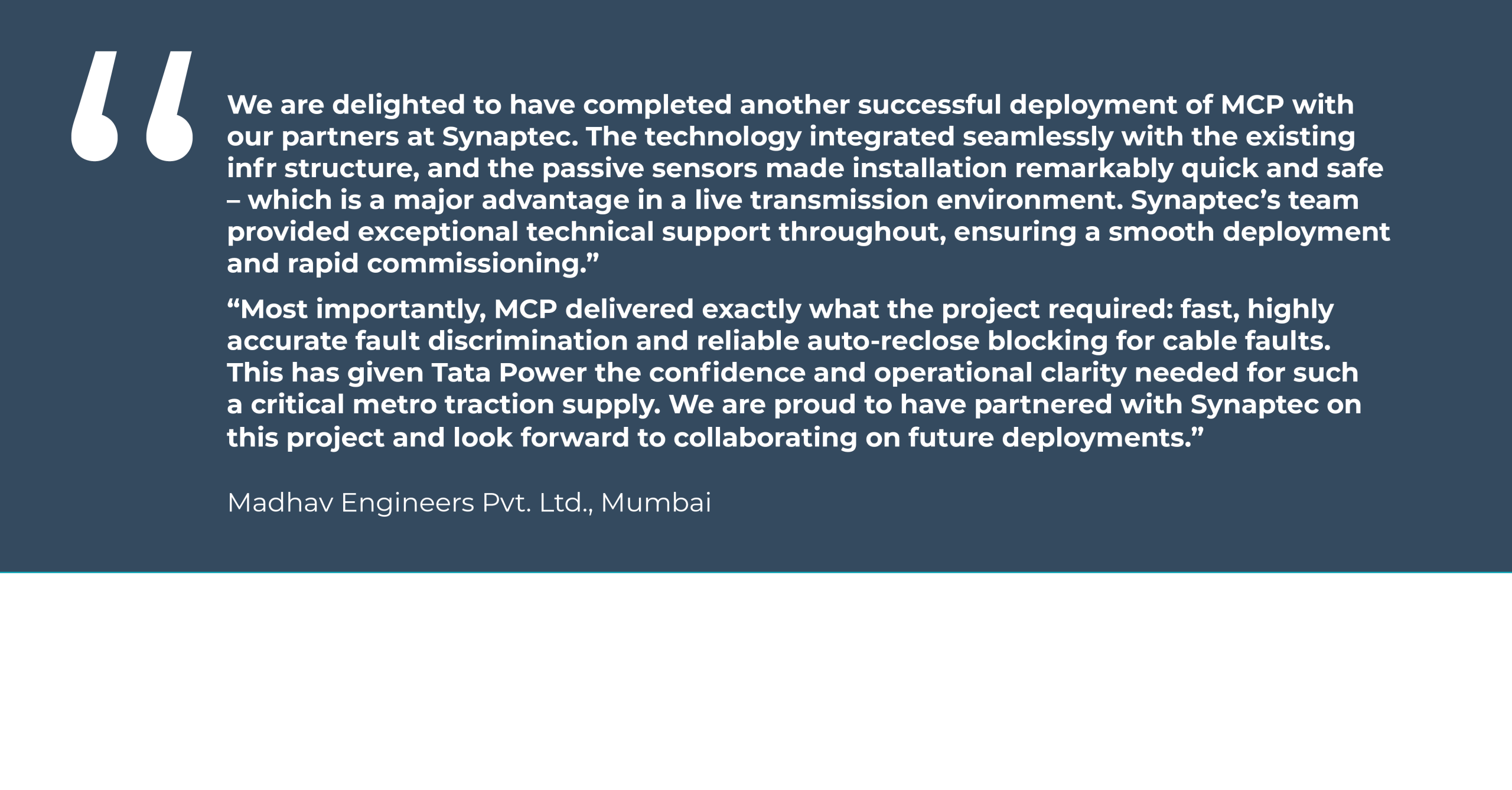
Testimonial
Book a demo
Our solutions provide real-time, actionable insights to improve reliability and reduce operational costs. Discover how Synaptec can enhance your power system monitoring by speaking to one of our team today.
Applications


Related posts

Advanced monitoring techniques for underground HV cables
https://www.youtube.com/watch?v=4b1Z9hcyDXk&t=18s

Panel discussion on visualising and analysing grid data
Sectors we support

Power grids

Renewables