
Remote transformer protection (RTP)
RTP is Synaptec’s protection for transformers far from any substation.
RTP gives a remote transformer unit protection with fault clearance at both ends, with your choice of 87T relay running its own settings. The transformer site needs only standard CTs, passive sensors, and a single fibre back to the substation.
RTP is part of Reflex, Synaptec’s range of ultrafast protection for complex and remote circuits and assets, and runs on Distributed Electrical Sensing (DES).
Get in touch

Aneesh Chandran
Sales Engineering lead

Prasanta Das
Regional Sales Director - India & Gulf States

Dr Oyedotun E. Oyewole
Sales Engineer
The industry challenge
Many transformers sit well away from any substation: step-down units on mid-route taps, supply points for mines and pumping stations, and transformers at the landing points of island links. Without a substation of their own, they rarely have unit protection. They rely on time-graded overcurrent protection from the feeding end and on mechanical devices such as Buchholz and pressure relief relays, which respond to the consequences of a fault rather than its onset.
Overcurrent protection clears in grading time rather than unit time, and cannot tell a line fault from a transformer fault. The longer an internal fault persists, the more likely the transformer needs replacing rather than repairing, and replacement lead times for large transformers now run to years. Where remote sites have been connected at all, it has usually been over pilot wires or telephone circuits, which are now being withdrawn.
The two conventional options
| Accept slow clearance | Build infrastructure at the transformer |
|---|---|
| Faults cleared in grading time rather than unit time | Relay, panel, auxiliary supplies, and batteries at the transformer |
| Fault damage increases with clearing time | A new communications channel to the site, fit for protection |
| Line and transformer faults cannot be told apart at the feeding end | Testing and maintenance visits for the life of the scheme |
| Transformer replacement lead times measured in years | Civil works to house the equipment at a site with no building |
Our solution
RTP forms three differential zones from one set of passive sensors, all measured at the feeding substation. Zone 1 covers the HV line from the feeding substation to the transformer HV terminals. Zone 2 covers the transformer from its HV to LV terminals, with a neutral CT for restricted earth fault protection. Zone 3 covers the LV line to the receiving substation. The two line zones run in the DES Interrogator, using the same 87L element as MCP. The transformer zone runs in your choice of 87T relay, which receives the HV, LV, and neutral currents as IEC 61850-9-2 Sampled Values and applies its existing settings.
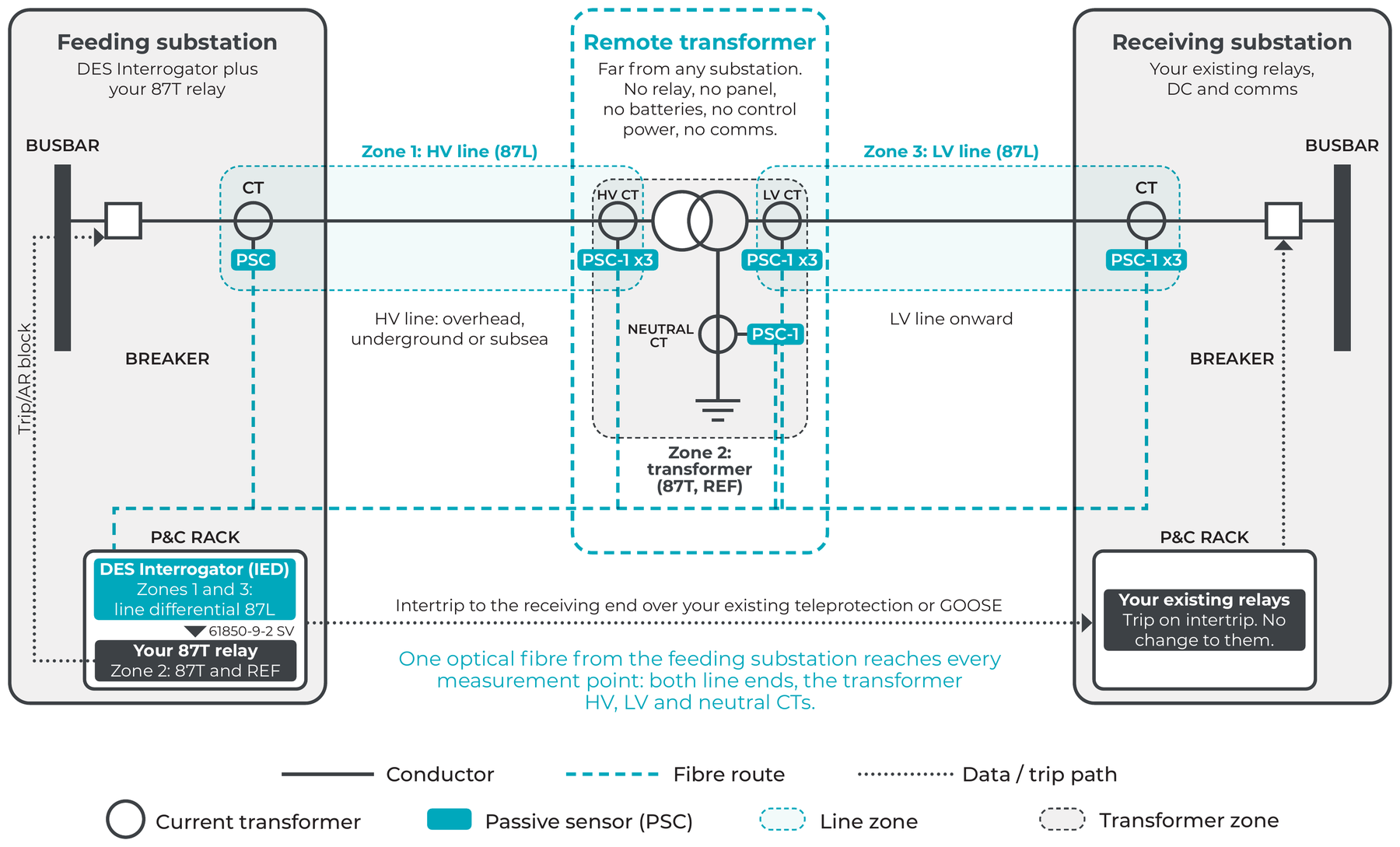
Three zones from one fibre: the line zones in the DES Interrogator, the transformer zone in your chosen 87T relay
How it works
At the transformer
Single-phase PSC-1-C sensors, rated IP68, connect to the secondaries of standard CTs: three on the HV side, three on the LV side, and one on the neutral. They are spliced into a spare fibre and need no further attention.
In the feeding substation
The DES Interrogator reads every sensor over the fibre on a common time base. It runs line differential protection on Zones 1 and 3, trips the local breaker by dry contact or GOOSE, and sends an intertrip to the receiving end. It also publishes the transformer’s HV, LV, and neutral currents to the process bus, from which your 87T relay runs Zone 2 exactly as it would from a conventional merging unit.
At the receiving substation
Three further sensors on the existing line CTs complete Zone 3. The breaker trips on the intertrip from the feeding end over your existing teleprotection or GOOSE link, and the relays in the existing panel are unchanged.
Protection functions
| Function | Zone | Runs in |
|---|---|---|
| Line differential (87L) | Zone 1, HV line; Zone 3, LV line | DES Interrogator |
| Transformer differential (87T) | Zone 2, HV to LV terminals | Your 87T relay, via Sampled Values |
| Restricted earth fault | Zone 2, using the neutral CT | Your 87T relay |
| Overcurrent and earth fault (50, 50G) | Any measured point | DES Interrogator or your relay |
| Auto-reclose blocking and faulted zone indication | Zones 1, 2, and 3 | DES Interrogator |
| Synchronised fault records | Every measurement point | DES Interrogator |
Performance
- Accuracy class 1/10TPM to IEC 61869-13.
- Response under 20 ms including relay operation, shown on the DES platform in a published 132 kV field trial.
- All measurements on one time base, synchronised to within one microsecond, with no satellite timing at the transformer.
- Only optical signals beyond the substation fence, immune to electromagnetic interference.
Integration
- The transformer stays protected by your own 87T relay and settings.
- IEC 61850-9-2 Sampled Values go to any compliant relay, and GOOSE or dry contacts go into your existing trip circuits and auto-reclose logic.
- Existing protection stays in service as backup during installation.
- Factory and site acceptance tests are carried out from the substations, without access to the transformer site.
Where it applies
Rural and island supplies
A step-down transformer on a long line feeding a village, island, or rural network. Both lines and the transformer have unit protection, including restricted earth fault, with tripping at both ends.
Industrial and infrastructure supply points
Mines, pumping and compressor stations, rail feeder sites, and similar loads supplied from a tap on a transmission or distribution line.
Island links
A subsea cable to a transformer at the landing point, with a line onward into the island network. Cable, transformer, and island-side faults are identified separately, so crews are sent knowing where the fault is.
Shunt reactors
The same arrangement protects a shunt reactor, with a reactor zone in your 87R relay in place of the transformer zone.
Proven in service
Reflex uses the same DES Interrogators and passive sensors that Synaptec supplies for protection and cable systems monitoring worldwide. In more than 1.5 million sensor-hours of operation, no Synaptec sensor has ever failed in service. The line zones in RTP use the same 87L element as MCP, which is in service with transmission and distribution operators in India, Europe, and the Middle East.
>1.5 million
sensor-hours of operation (October 2026)
0
sensor failures in service
>60 km
from the substation to the furthest passive sensor
Reflex brochure
The Reflex brochure covers MCP and RTP, how each one works, and the service record of the Synaptec passive sensors and DES Interrogators they share, in eight pages.
Talk to us about your remote transformers
Start with one circuit. Send us the single-line diagram and the fibre route, and we will propose a protection design with a budget price, at no cost. Your preferred contractor or Synaptec’s local partner installs the equipment, and Synaptec commissions it.
Applications


Related posts
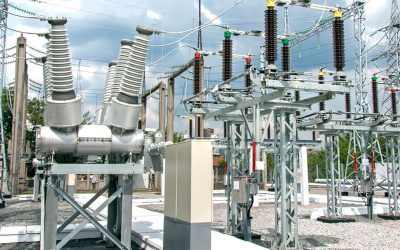
Mixed Circuit Protection (MCP)
Mixed Circuit Protection (MCP) is Synaptec’s solution to eliminate the risk of auto-reclosing on a permanent cable fault. MCP utilises Synaptec’s platform technology, Distributed Electrical Sensing (DES), to instantly detect whether a fault has occurred on a cable...
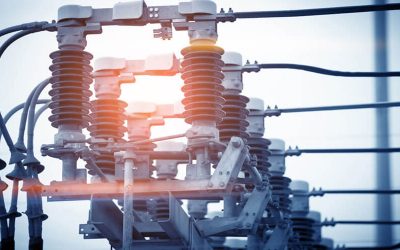
Distributed Electrical Sensing (DES)
We reduce outage and operational cost with the world’s only distributed sensor technology for operators of complex power systems. Our passive sensors require no power or data networks, and provide live data more reliably and securely from more locations than...
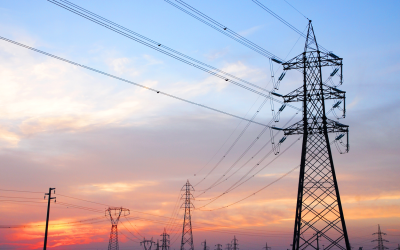
Line differential protection for long-distance remote assets using passive optical sensing
CIGRE B5 Colloquium 2025 Authors: Iain Mckeeman, Elliot Hale, Fraser Cadger, Neil Gordon, Steven Blair Date published: July 2025 Summary Distinguishing between faults on mixed conductor circuits can be challenging when relying only on measurements from within the...
Sectors we support

Power grids

Renewables