HV cable health monitoring
Greenlight® is Synaptec’s HV cable health monitoring solution for underground and subsea cables.
Greenlight finds damage and degradation at every joint and termination before they cause an outage, and it does so with nothing powered along the route.
Greenlight is built from three sensing modules on the fibre already laid with the cable. Distributed Electrical Sensing (DES) measures phase and screen current at every joint and termination. Point temperature sensing (PTS) measures temperature at the same joints and terminations. Distributed temperature sensing (DTS) measures temperature along the whole route.
All three are read in the substation on one time base and analysed on one platform, so a temperature rise at a joint can be checked against the current flowing there, and a current anomaly against the temperature at the same place.
Get in touch

Aneesh Chandran
Sales Engineering lead

Prasanta Das
Regional Sales Director - India & Gulf States

Dr Oyedotun E. Oyewole
Sales Engineer
About Greenlight
Learn more about Greenlight from Synaptec’s cofounder and CEO, Dr Philip Orr, and VP Operations, Dr Steven Blair.
What is Greenlight®?
Discover more on what Greenlight is, how it works and how it helps operators.
How does Greenlight® provide early warning of failures?
Learn more about early warning of failures, helping operators save significant costs.
Why do operators need Greenlight®?
Find out what the early adopters are saying, and what sort of savings you could be making.
What Greenlight measures
Everything active sits in the substation. Along the route there are only passive sensors and the fibre already laid with the cable.
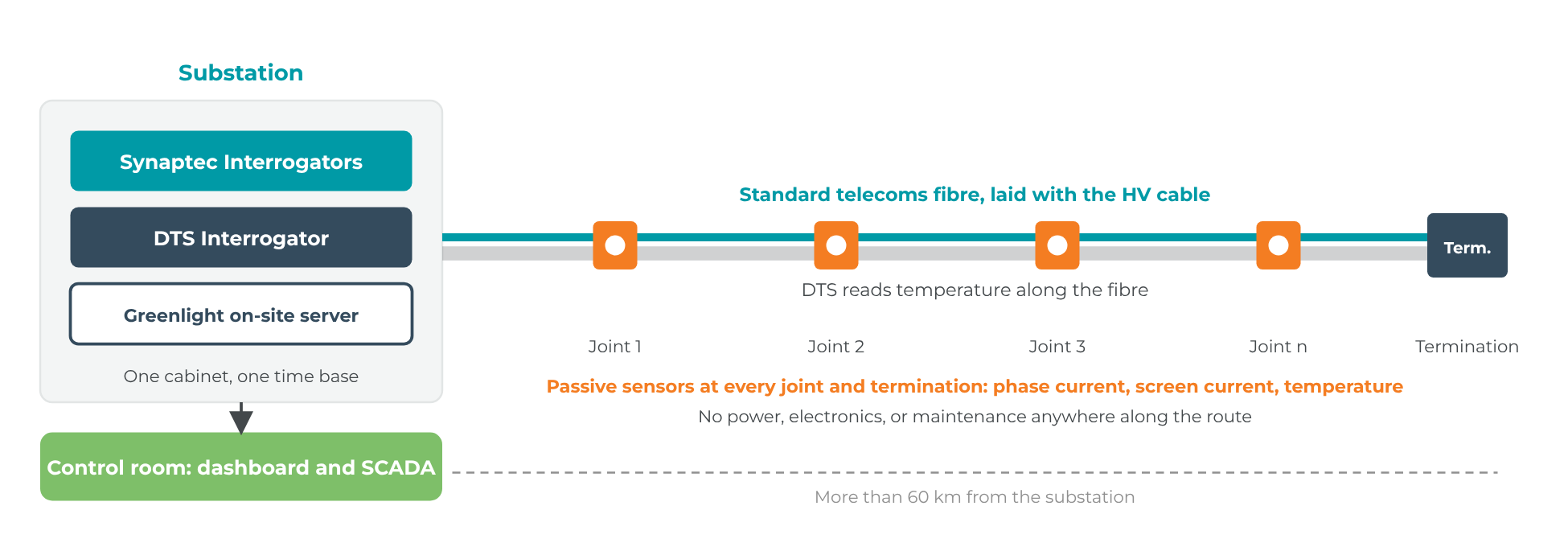
At every joint and termination
Phase current, screen current, and temperature are measured by passive sensors on split-core current transformers and by passive temperature transducers. This gives early warning of bonding faults, water ingress, and degradation, located to the accessory.
Along the whole route
The fibre itself gives a continuous temperature profile. It shows hot spots and cold spots between joints, the thermal history of every section, and fibre integrity.
In one platform
The Greenlight analytics correlate electrical and thermal data at every location, remove seasonal effects, and raise alarms and event records into your SCADA. Data stays on your own server.
Key benefits
- Works with any HV cable. Greenlight works with any HV cable from any manufacturer, underground or subsea, solid-bonded or cross-bonded. It retrofits at link boxes, joint bays, and landfalls on circuits already in service, so you choose your cable and your monitoring separately.
- Phase and screen current at every joint and termination. Passive sensors measure phase and screen (sheath) currents over standard telecoms fibre, at more than 60 km from the substation. Screen currents contain the earliest electrical indicators of bonding faults, water ingress, or failing joints.
- No power or maintenance at site. The sensors are passive. They need no control power, no data network, no batteries, and no recalibration, and once installed they report for the life of the cable.
- Electrical and thermal measurements compared. Current and temperature are compared location by location, so a hot joint is confirmed by its current and a current anomaly by its temperature. This gives earlier warnings and fewer false alarms.
- Event counts at every joint and termination. Greenlight counts events at every joint and termination, so you can see where activity is building and target maintenance before a failure.
- Further modules on the same fibre. Real-time thermal rating and distributed acoustic sensing can be added as modules on the same fibre and the same platform.
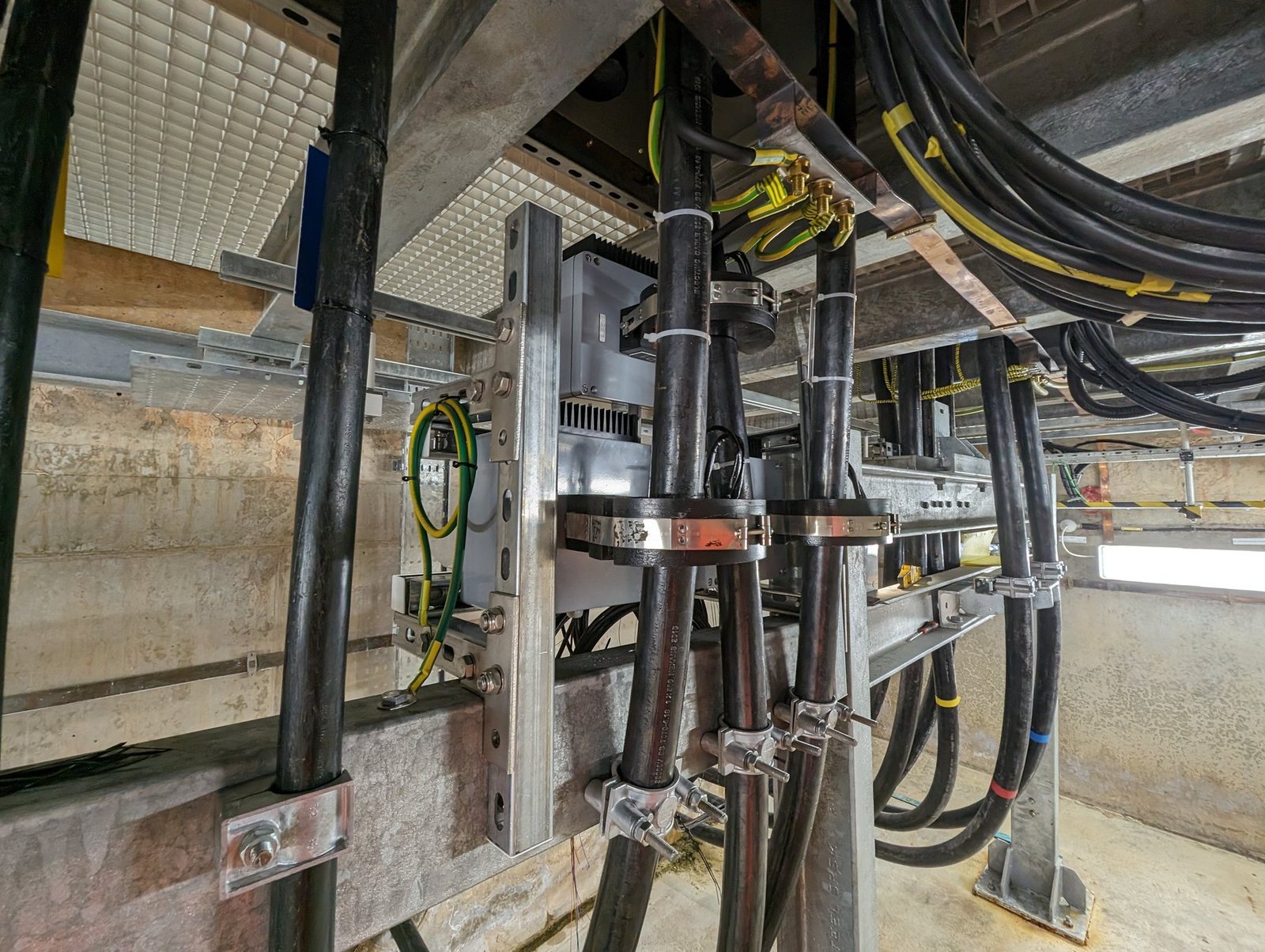
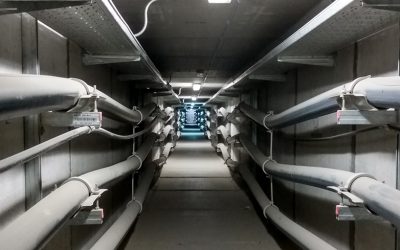
Split-core CTs with passive sensors fitted around HV cables in a substation cable cellar
Why monitor the whole HV cable
Cable failures are expensive and slow to repair. A single HV cable failure can cost more than £80M in lost revenue, and cables account for 80% of insurance claims in offshore wind. On land, 57% of HV cable downtime comes from joints and terminations rather than the cable itself, and those are the places conventional monitoring does not reach.
Temperature alone finds a hot joint once it has started to fail. Current alone finds an electrical fault without its thermal cause. Measuring both, at the same places and on the same time base, finds the problem earlier and with fewer false alarms.
57%
of HV cable downtime is caused by joints and terminations1
£80M+
lost income from a single preventable HV cable failure2
80%
of offshore wind insurance claims relate to cables3
Screen current monitoring
The current flowing in the metallic screen or sheath at each joint depends on the bonding arrangement, the condition of the link box and earthing, and the state of the insulation. A change in screen current, or in its ratio to the phase current, points to a bonding fault, water ingress, or a deteriorating joint long before a failure, and the comparison between joints shows which one. Greenlight measures it continuously at every joint and termination. Utilities and tender specifications often call this sheath current monitoring.
Monitoring that belongs to the network operator
HV cable systems monitoring can be designed into a cable at manufacture and bought with it, or specified and procured on its own. Greenlight is designed for the second route, so the monitoring belongs to you, works on any cable you own, and is not tied to one cable supplier for the life of the asset. It retrofits at link boxes and joint bays without disconnecting the circuit, and connects to your systems through IEC 61850, IEC 60870-5-104, Modbus, DNP3, OPC UA, or a secure REST API.
1 CIGRE WG B1.57, Update of service experience of HV underground and submarine cable systems, TB 815, 2020.
2 Ofgem final direction, GyM-SSEC3, December 2024.
3 DNV, insurance claims in offshore wind related to subsea cable failures.
Greenlight modules
DES, PTS, and DTS form the core of Greenlight, and the Greenlight software compares every sensor against its own history and against the others on the circuit, with seasonal effects removed, so alarms are raised only for real changes.
DES: phase and screen current
Measures: phase and screen currents at every joint and termination, sampled at up to 4.8 kHz and time-stamped centrally.
You get: early warning of joint, termination, and bonding faults, located to the accessory, with an event record for each.
PTS: point temperature
Measures: temperature at every joint and termination, from passive temperature transducers read by a DMS Interrogator.
You get: hot joints and terminations, checked against the current flowing through them.
DTS: temperature along the route
Measures: a continuous temperature profile along the cable, from the fibre itself.
You get: hot spots and cold spots along the route, the thermal history of every section, and fibre integrity.
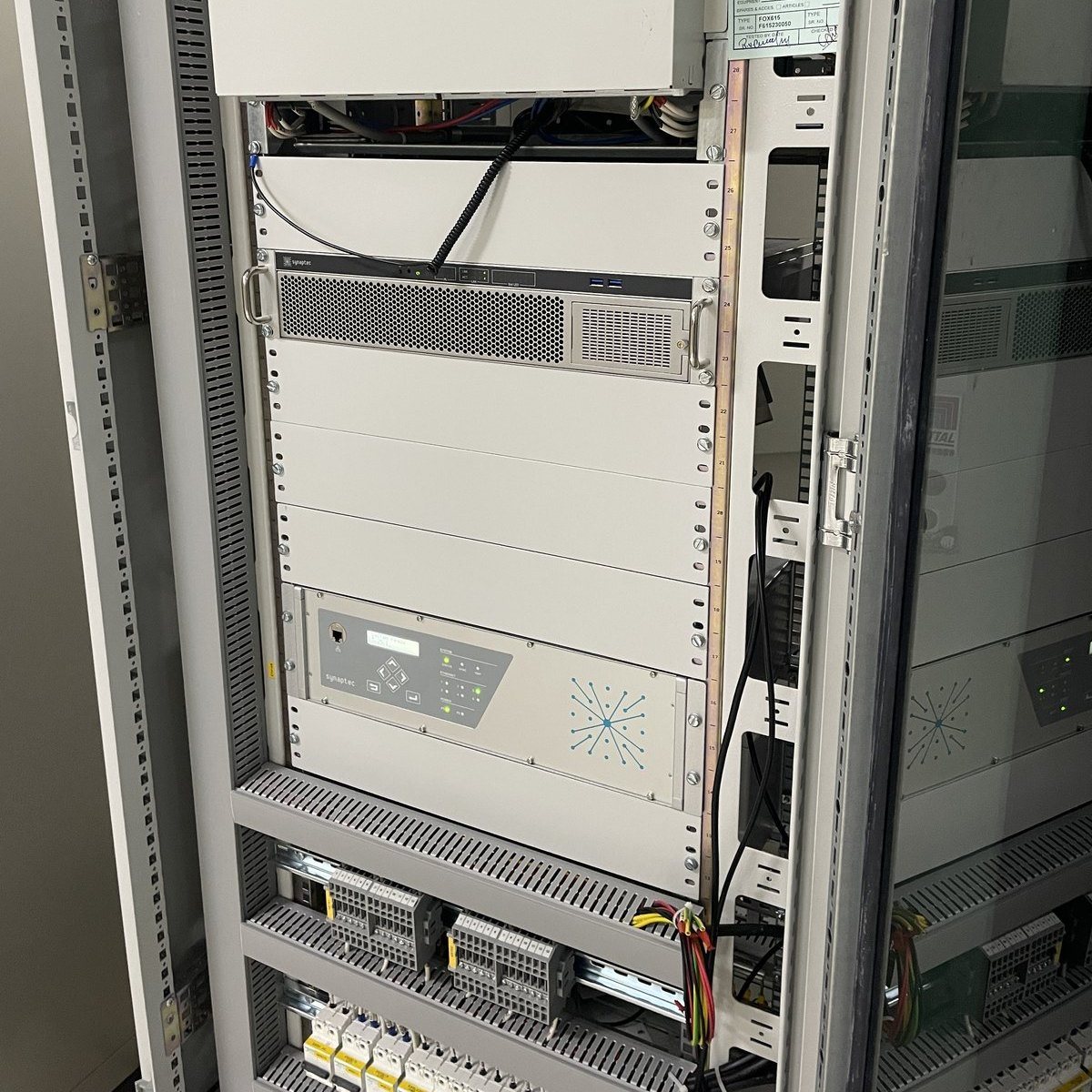
Synaptec Interrogator in a substation rack in Mumbai
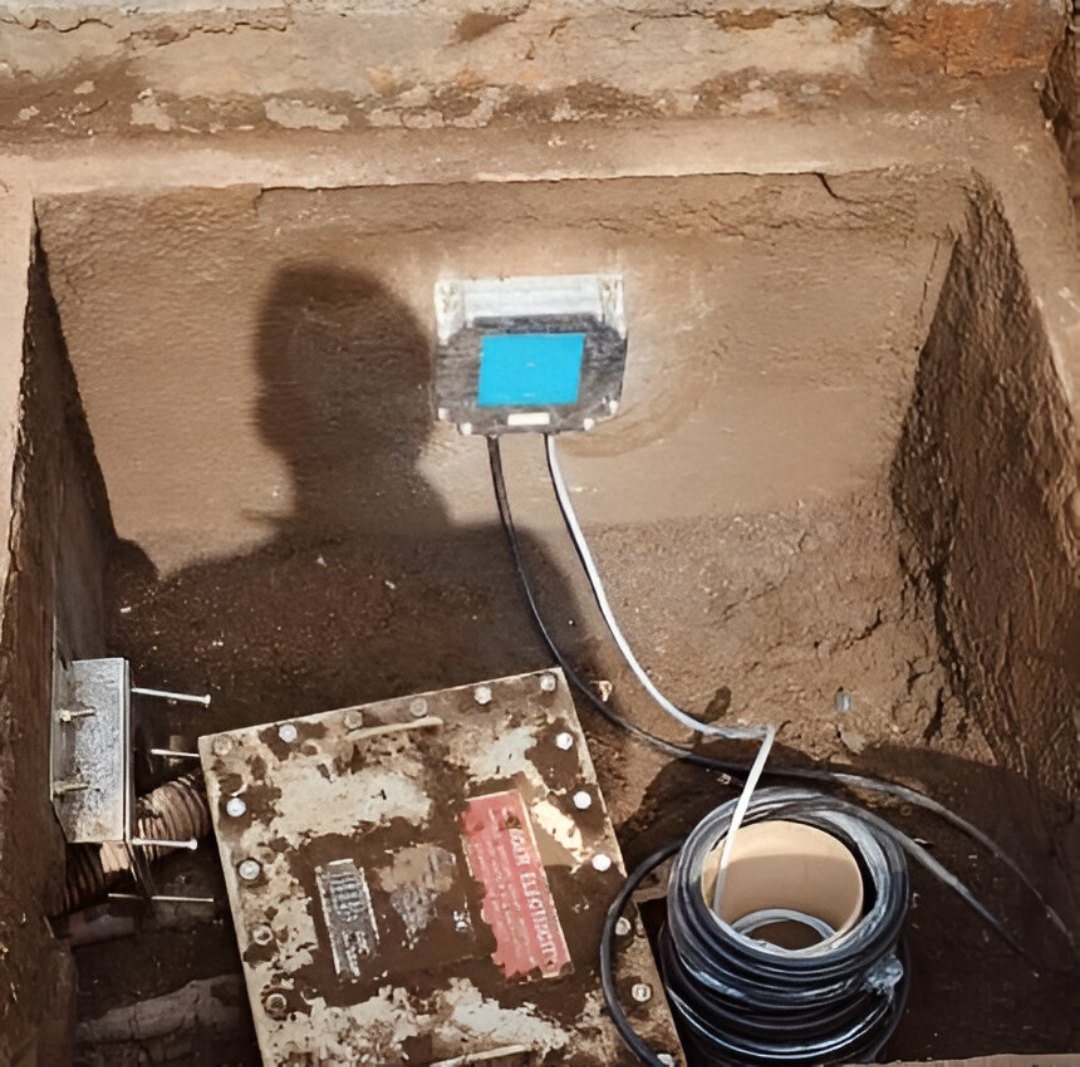
Passive sensor installed in a joint bay in Mumbai
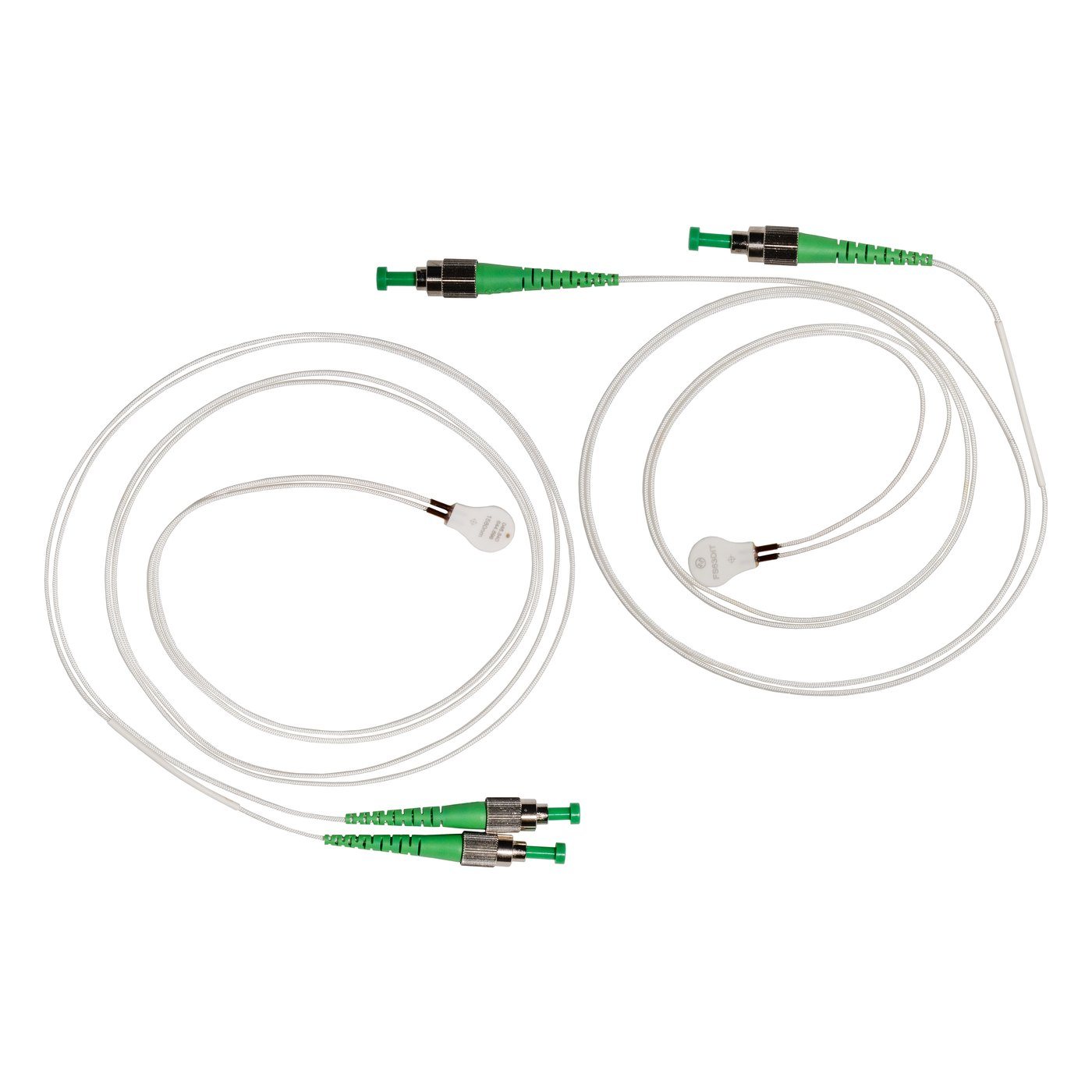
Passive temperature transducer, which needs no power or maintenance
Modules that can be added
These modules can be added on the same fibre and the same platform.
Real-time thermal rating (RTTR)
A Greenlight module delivered in close partnership with cable thermal rating specialists. It combines the temperature measured along the route with the current measured at the cable, and reports conductor temperature and the load the circuit can carry for the hours ahead.
Distributed acoustic sensing (DAS)
DAS detects, classifies, and locates digging, drilling, and heavy plant along the route before the cable is struck, on the same fibre.
How it works
Passive sensors
Synaptec’s passive sensors combine industry-standard instrument transformers with Distributed Electrical Sensing. Split-core current transformers fit around the cable or bonding lead for retrofit without disconnection, and a Passive Secondary Converter (PSC) instruments the CT secondary, encoding it as an optical signal on single-mode telecoms fibre with no power supply or electronics at the sensor. Many sensors share one fibre and are read from the substation, more than 60 km away. Passive temperature transducers sit alongside them at joints and terminations, so electrical and thermal measurements come from the same places.
Synaptec Interrogators
Rack-mounted Synaptec Interrogators in the substation read every sensor on one time base. DES and mDES Interrogators read the current sensors, sampling at up to 4.8 kHz, and DMS Interrogators read the passive temperature transducers. Their measurements pass to the Greenlight server, where the analytics capture an event record whenever behaviour changes.
Distributed temperature sensing
Greenlight integrates a DTS Interrogator that uses the fibre itself as a continuous temperature sensor along the full route. The temperature profile is correlated with the electrical measurements at each joint, so a hot spot is confirmed by its current and a current anomaly by its temperature.
Greenlight software
An on-site server records, stores, and correlates all of the data inside your network. The analytics search every sensor and every group of sensors for behaviour that has changed, remove seasonal effects, and raise alarms and event records into your SCADA by IEC 61850 or IEC 60870-5-104. A secure REST API makes the data available to your own systems.
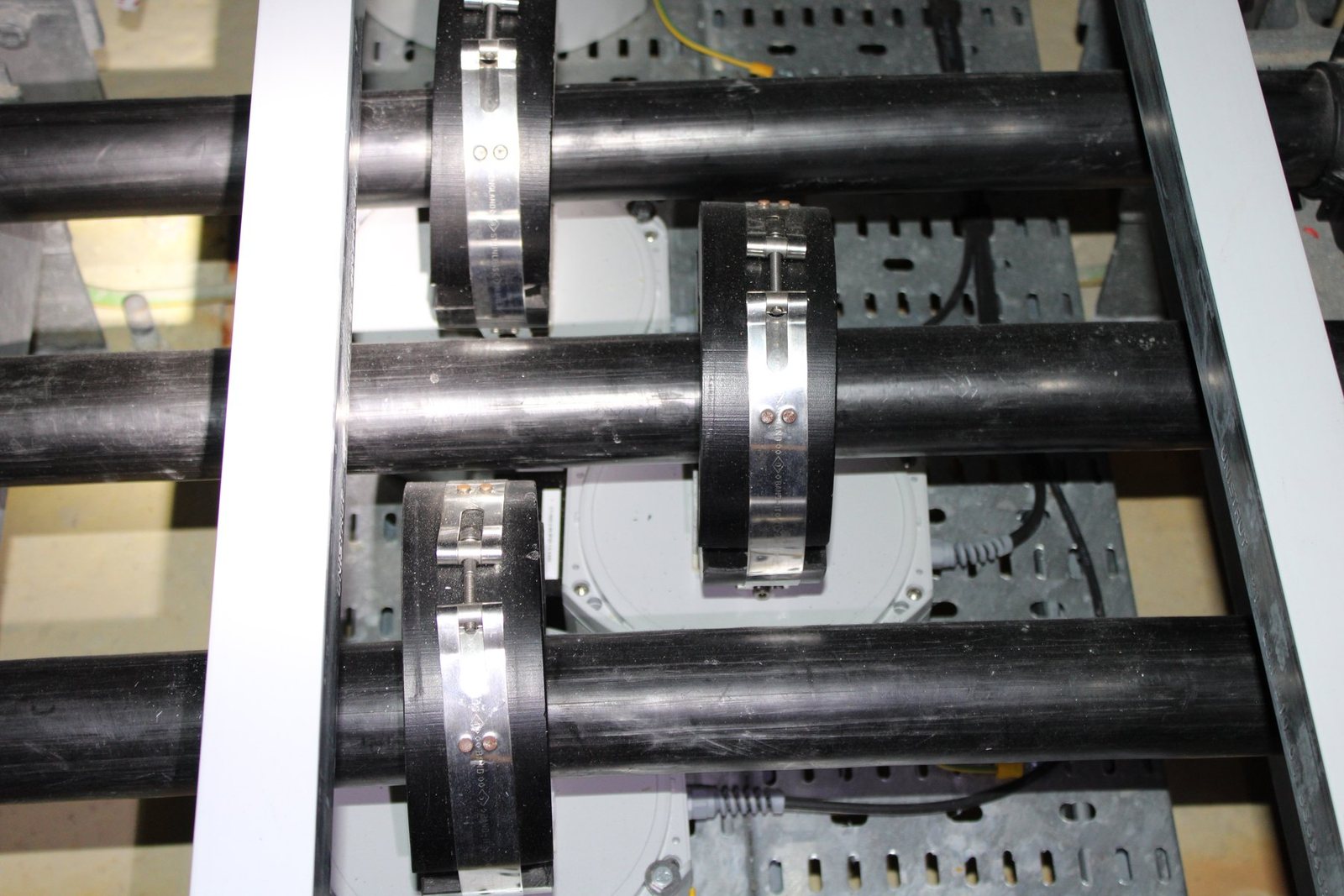
Split-core CTs fit around each cable for retrofit without disconnection
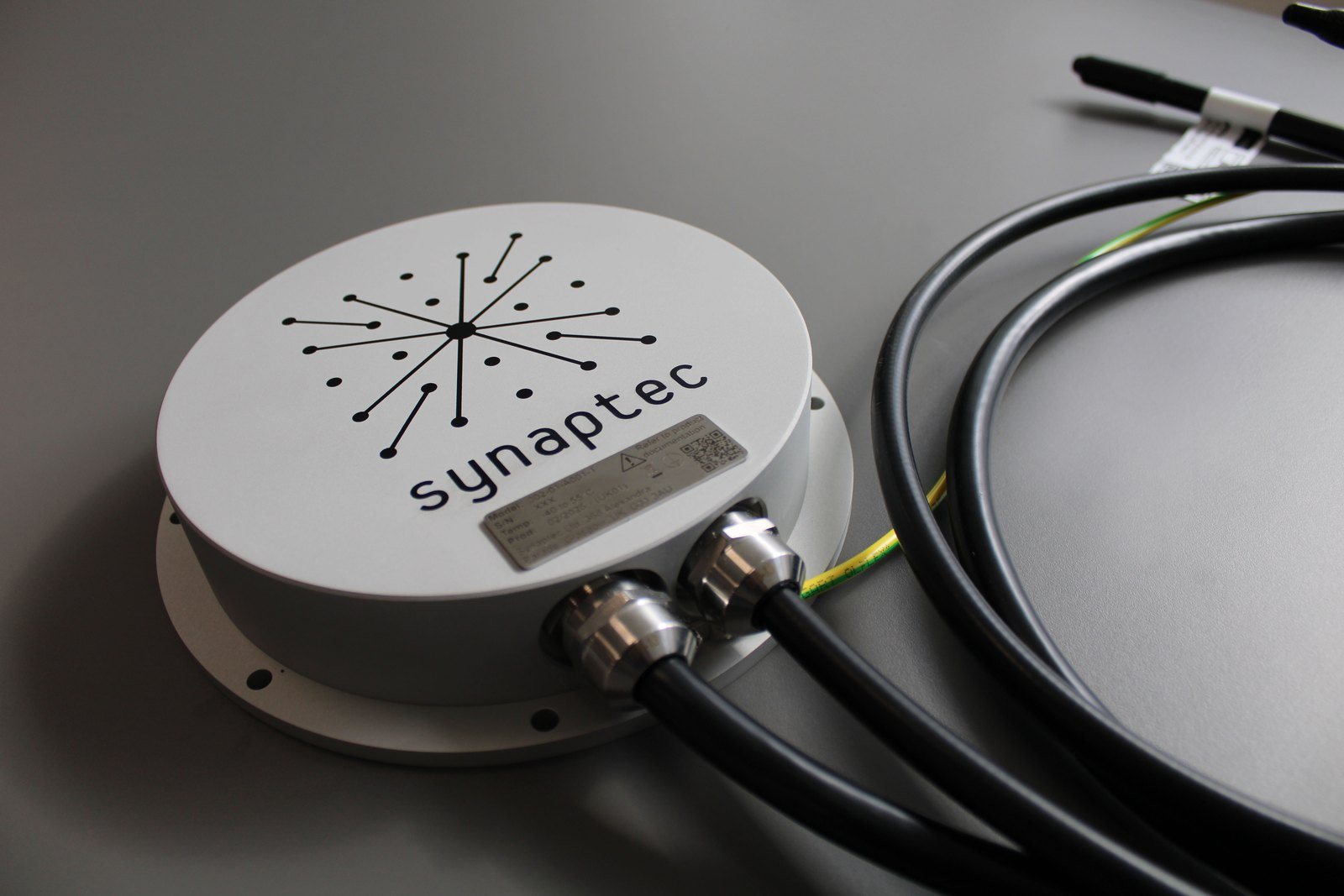
PSC-1 Passive Secondary Converter, with no power supply or electronics at the sensor
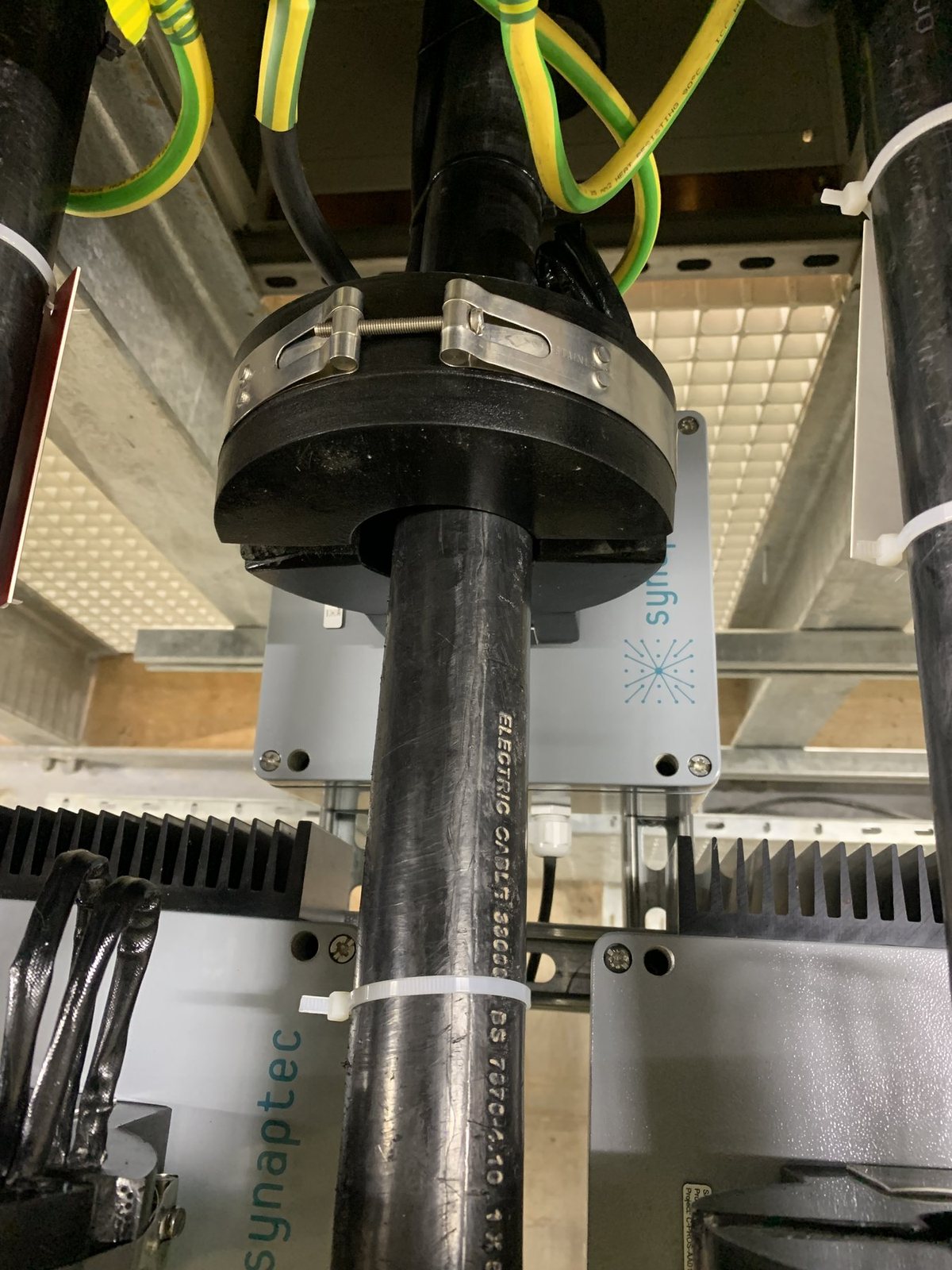
Split-core CT on an HV cable, with its passive sensor mounted behind
The Greenlight dashboard
Greenlight’s analytics run continuously on the on-site server, searching every sensor and every group of sensors for behaviour that has changed. The dashboard shows the whole circuit in one view: every joint and termination, and the temperature profile along the route.
- One view of the circuit. Processed data from every HV cable section, joint, and termination is shown with the temperature profile along the route. Abnormal behaviour, such as a joint running hot while its current is normal, is highlighted for maintenance.
- Derived metrics. Derived metrics are measured and trended at every joint. Changes in correlations and relationships, or differences between joints, reveal installation errors, bonding faults, and water ingress long before a failure (CIGRE TB 825).
- Outlier analysis. Greenlight finds deviations in any sensor against its own history, against other sensors on the circuit, and in derived metrics such as the screen current difference across a section. Seasonal effects are removed, so only real changes raise an alarm.
- Alarms and records. Every anomaly produces an event record, and event counts by joint and termination show where activity is building, so maintenance can be targeted before a failure. Alarms go to your SCADA by IEC 61850 or IEC 60870-5-104, and a secure REST API serves your own systems.
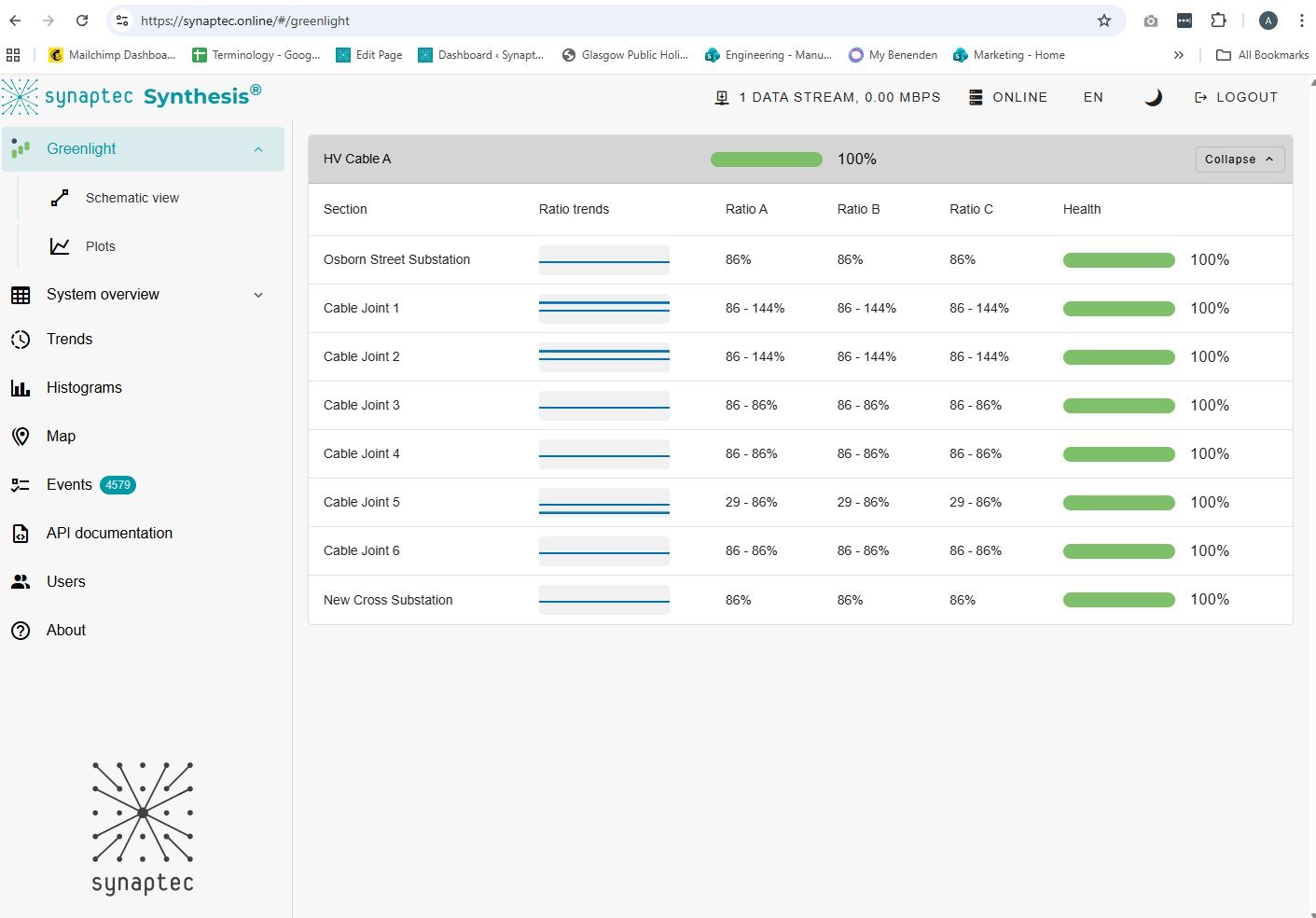
Greenlight dashboard: the health of every section of the circuit in one view
How Greenlight is delivered
Synaptec leads the project from design to handover and is your single point of contact. Your preferred contractor or Synaptec’s local partner installs the equipment, and first-line support is provided locally. Software licences are perpetual, paid once.
- Design, specification response, and project lead: Synaptec
- Passive sensors, Synaptec Interrogators, DTS, and software platform: Synaptec
- Installation, splicing, cabinets, and site works: your preferred contractor or Synaptec’s local partner
- Commissioning and training: Synaptec
- Support: Synaptec, with local first-line support where a partner is in place
Proven in service
Greenlight uses the same Synaptec Interrogators and passive sensors as Synaptec’s cable protection schemes, so the two share one service record. In more than 1.5 million sensor-hours of operation, no Synaptec sensor has ever failed in service.
>1.5 million
sensor-hours of operation (October 2026)
>60 km
from the substation to the furthest passive sensor
0
sensor failures in service
Transmission and distribution utilities
Cable protection and monitoring on HV circuits across Europe, the Middle East, and India.
Offshore wind
Cable systems monitoring on North Sea wind farms, including Dogger Bank, Hywind Scotland, and Aberdeen Bay.
Urban underground cables
Sheath current monitoring and cable protection on 110 kV and 220 kV circuits for both private utilities serving Mumbai.
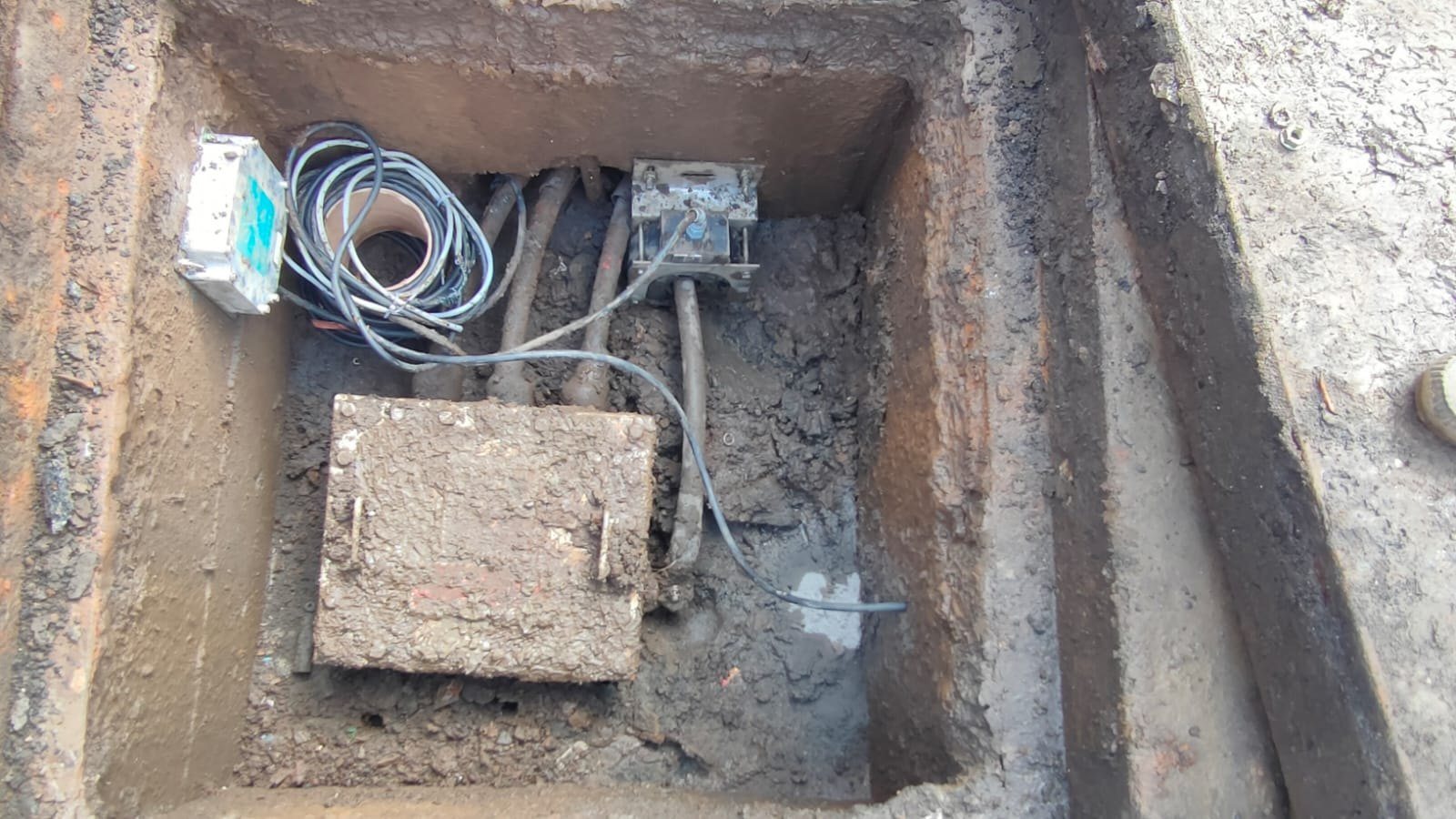
A monitored joint bay on the Aarey to Borivali route
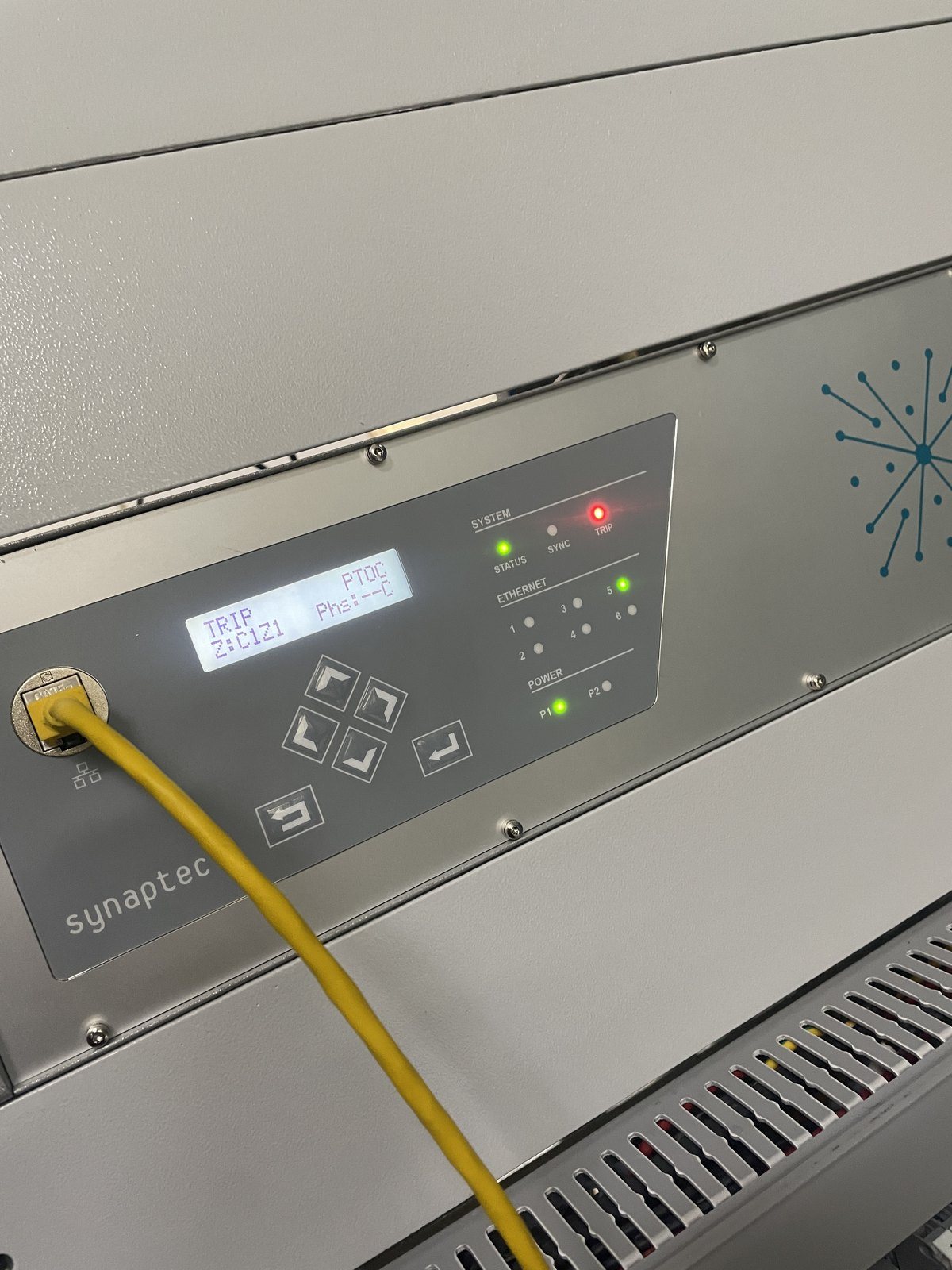
Synaptec Interrogator in service at a 220 kV substation in Mumbai
In service: Adani Electricity Mumbai, 220 kV Aarey to Borivali
Greenlight® screen current monitoring at 12 joint bays on a 12.7 km underground double circuit, retrofitted to the existing link boxes with the circuit in service. The first data after commissioning showed screen current at one joint bay on one circuit at more than ten times the level elsewhere. The analysis located the cause to a high-resistance bonding connection at an uninstrumented joint bay two sections away. The operator found it there, re-torqued it during a scheduled visit, and the excess current disappeared. No outage was taken and no confined-space survey was needed.
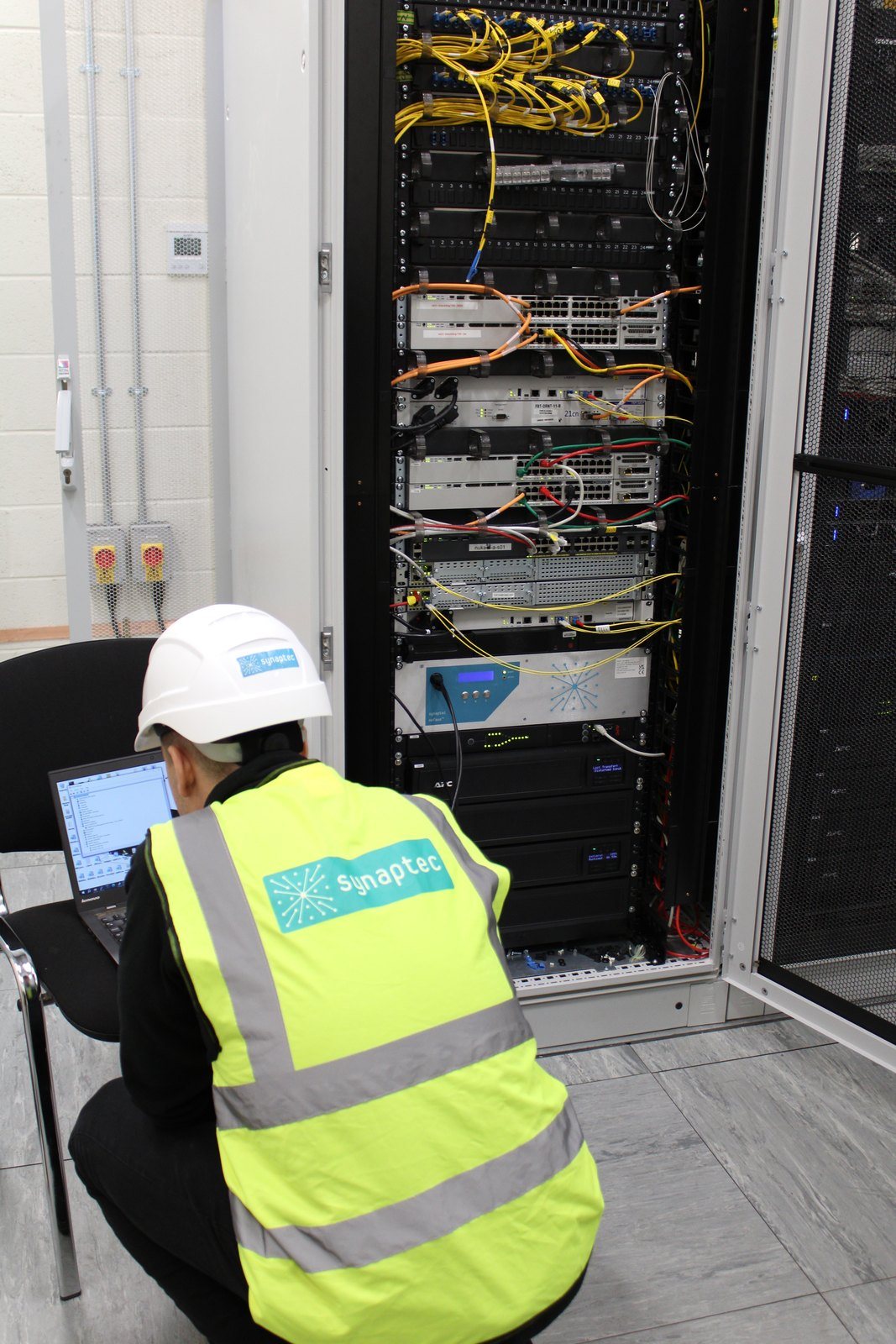
Commissioning at an offshore wind onshore substation
Greenlight brochure
The Greenlight brochure covers the system architecture, the modules, the dashboard, delivery, and the service record in eight pages.
Talk to us about your HV cable network
Start with one circuit. We will review the route, the fibre, and the accessories, and propose a monitoring design with a budget price, at no cost. Most circuits can be fitted without an outage.
Applications


Related posts
The Distributed Mechanical Sensing (DMS) Interrogator
The Distributed Mechanical Sensing (DMS) Interrogator is designed for monitoring of large numbers of point temperature sensors with unprecedented efficiency. The DMS Interrogator allows up to 20 temperature sensors per channel to be multiplexed across up to 8 channels.

Passive Secondary Converter for Current – Three-Phase (PSC3-C) Gen2
The PSC-3-C is Synaptec’s passive, three-phase analogue current sensor for power network applications. It converts Current Transformer (CT) secondary currents into optical signals to be measured, synchronised and digitised over long distances without the need for...
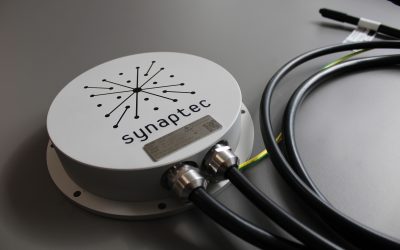
Passive Secondary Converter for Current – Single-Phase (PSC1-C) Gen2
The PSC-1-C is Synaptec’s passive analogue current sensor for power network applications. It converts Current Transformer (CT) secondary current into an optical signal to be measured, synchronised and digitised over long distances without the need for auxiliary power,...
Sectors we support

Power grids
Renewables